
Worked exampleExported from Calvance
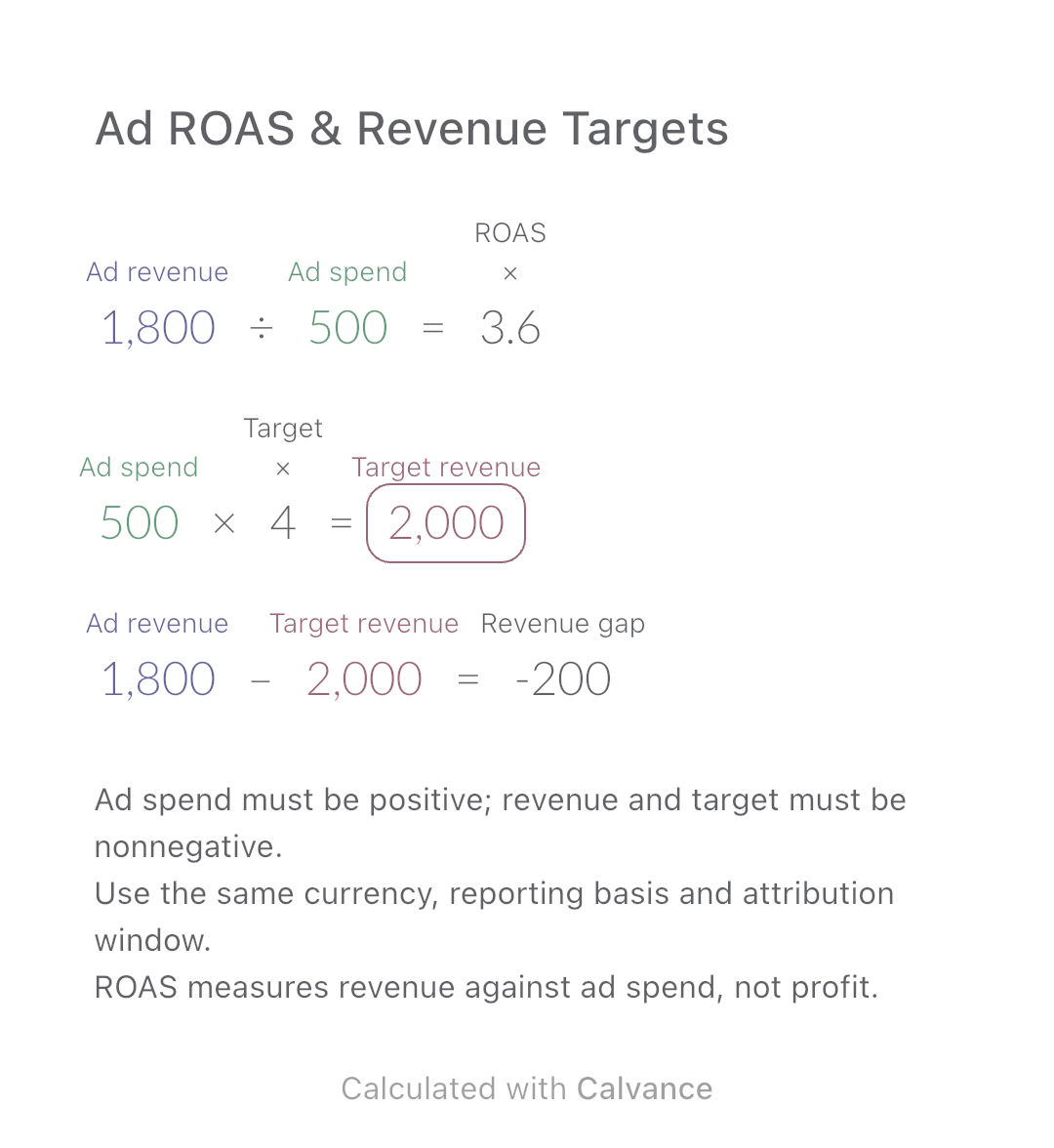
Ad ROAS & Revenue Targets
Calculate attributed revenue per advertising dollar and the gap to your own ROAS target. Includes a worked example, scope checks and an editable canvas.
View template and methodCalculate whole-unit break-even sales including a fee based on selling price. See how a price cut changes contribution, required units and the remaining balance.
Exported by the iOS App After importing, edit the numbers in Calvance.
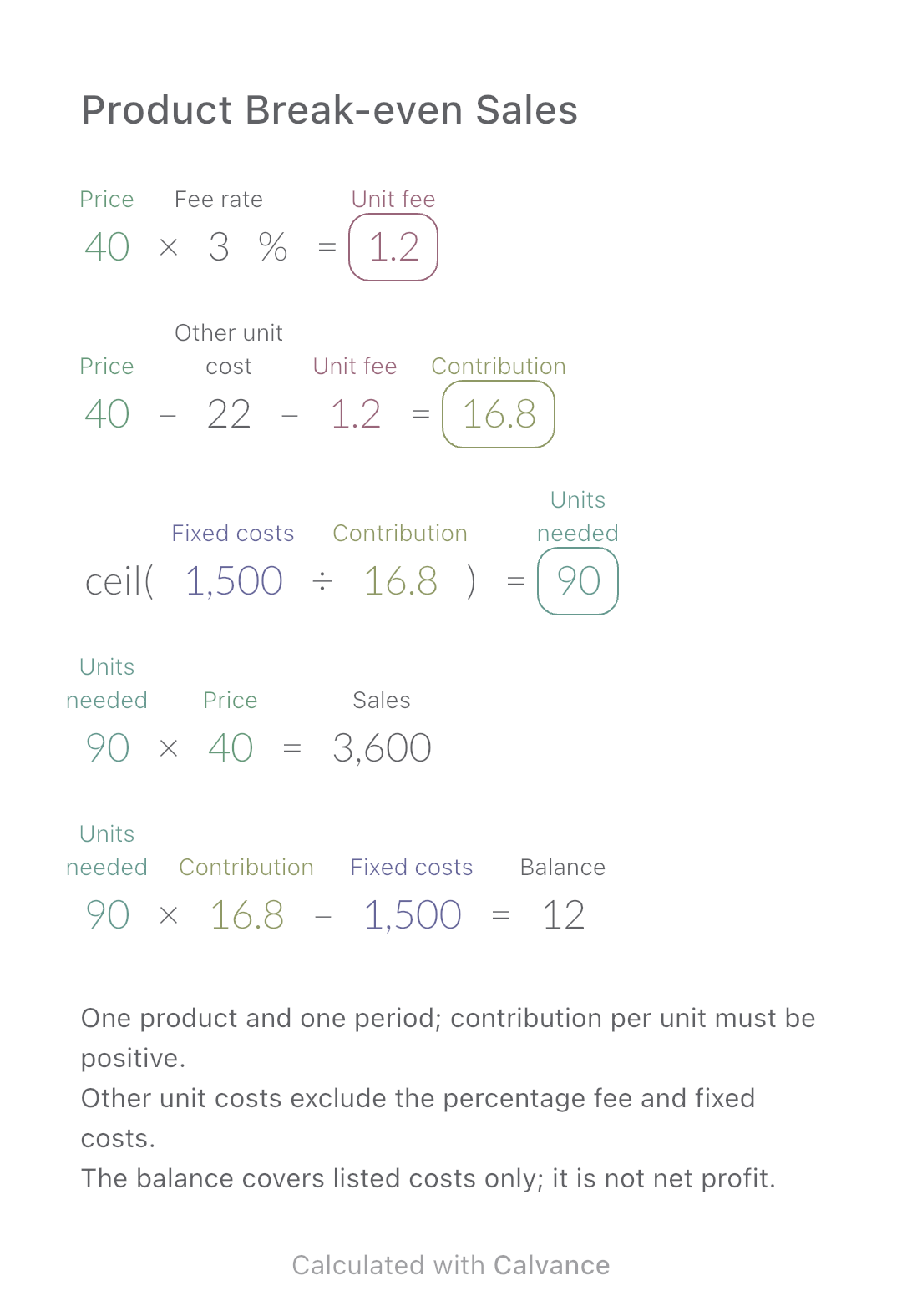
For one product over a fixed period, estimate how many whole units must sell to cover the costs you list. The simulated USD example includes a fee charged as a percentage of each item’s selling price. It is not a multi-product forecast or a cash-flow plan.
USD
| Inputs | Default |
|---|---|
| Realized price per item | 40 |
| Other variable costs per item | 22 |
| Fee on selling price (%) | 3 |
| Fixed costs for the period | 1,500 |
Unit fee = price × fee rate. Unit contribution = price − other unit variable costs − fee. Divide period fixed costs by positive contribution and round upward to whole units. Sales = required units × price. Remaining balance = required units × unit contribution − fixed costs. At $40 per item, $22 other unit costs, a 3% fee and $1,500 fixed costs, 90 units leave $12; 89 units leave −$4.80.
40 [Realized price per item] × 3 [Fee on selling price]% → Fee per item
Realized price per item - 22 [Other variable costs per item] - Fee per item → Contribution per item
ceil(1,500 [Fixed costs for the period]/Contribution per item) → Minimum whole units
Minimum whole units × Realized price per item → Sales at that volume
Minimum whole units × Contribution per item - Fixed costs for the period → Balance after listed costs
Change only the selling price from $40 to $36. The percentage fee also falls, from $1.20 to $1.08. Required sales rise from 90 to 117 units. Keeping the old dollar fee fixed would give a different, incorrect model.
| Result | Default | Changed |
|---|---|---|
| Fee per item | 1.2 | 1.08 |
| Contribution per item | 16.8 | 12.92 |
| Minimum whole units | 90 | 117 |
| Sales at that volume | 3,600 | 4,212 |
| Balance after listed costs | 12 | 11.64 |
Results are displayed to at most two decimal places; later formulas use unrounded values.
Price must be positive, costs nonnegative and the fee rate at least 0% and below 100%. Use the selling price after discounts and excluding sales tax. The fee must use that same base. Include other per-unit selling and fulfilment costs in the unit-cost input, without counting them again as fixed costs. Tiered fees, minimum charges, returns, unsold inventory payments, mixed products and capacity changes are outside scope. Check whether the required volume can actually be sold.
Download and import into Calvance to edit the numbers. The canvas does not reject every invalid input; check the stated ranges.
Whole items cannot be split. Rounding up gives the first whole-unit volume that covers listed costs; the previous unit must still fall short.
The formula cannot give a useful threshold. With positive contribution and zero fixed costs, the threshold is zero units.
The SBA single-product formula uses fixed costs divided by price minus unit variable costs. Here the percentage fee is explicitly part of variable costs.
For class enrollment use workshop break-even; for cash needed before opening use shop opening budget.
Calculate attributed revenue per advertising dollar and the gap to your own ROAS target. Includes a worked example, scope checks and an editable canvas.
View template and method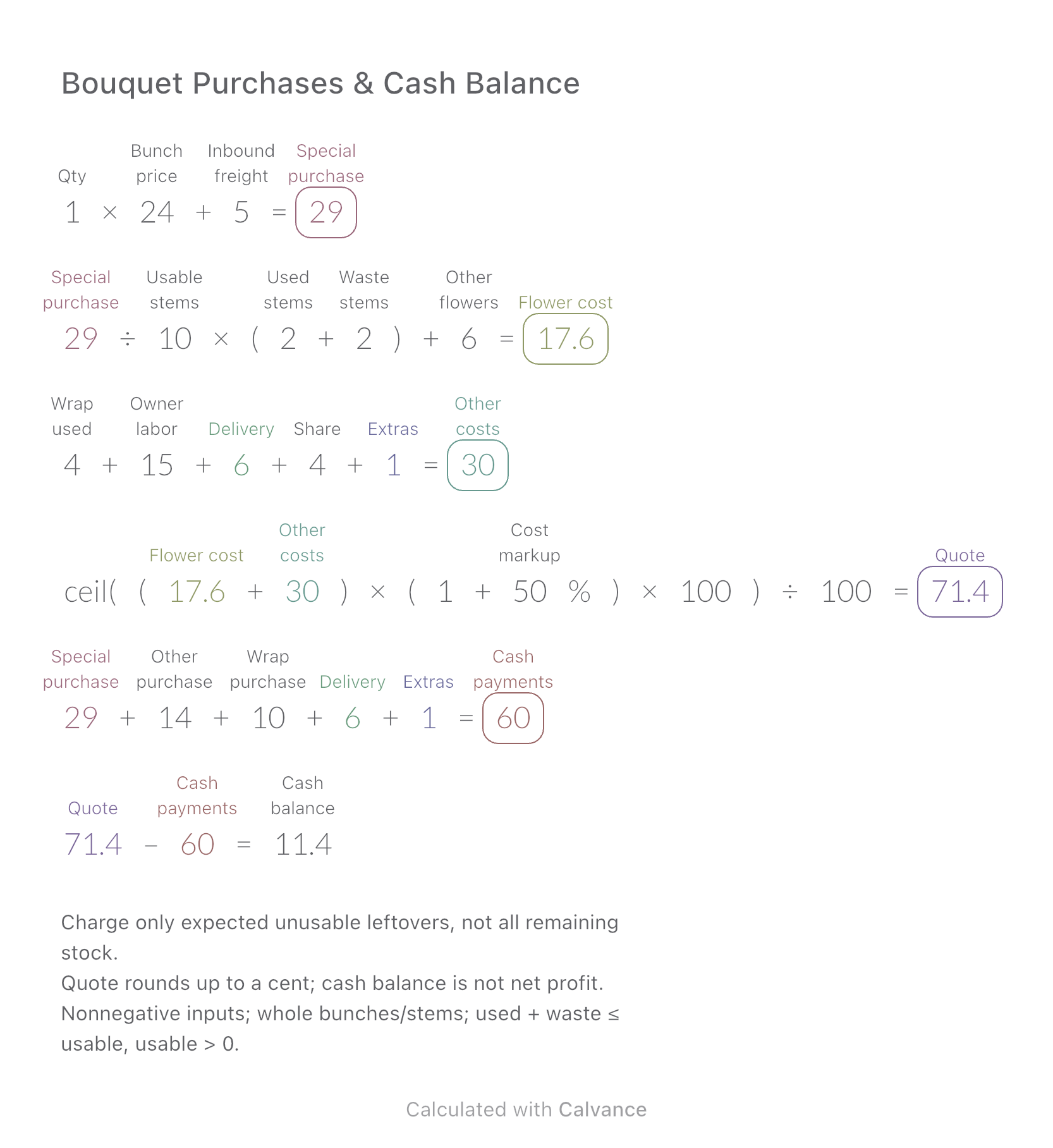
Compare the cost of flowers used in one bouquet with the cash needed to buy whole bunches and packaging.
View template and method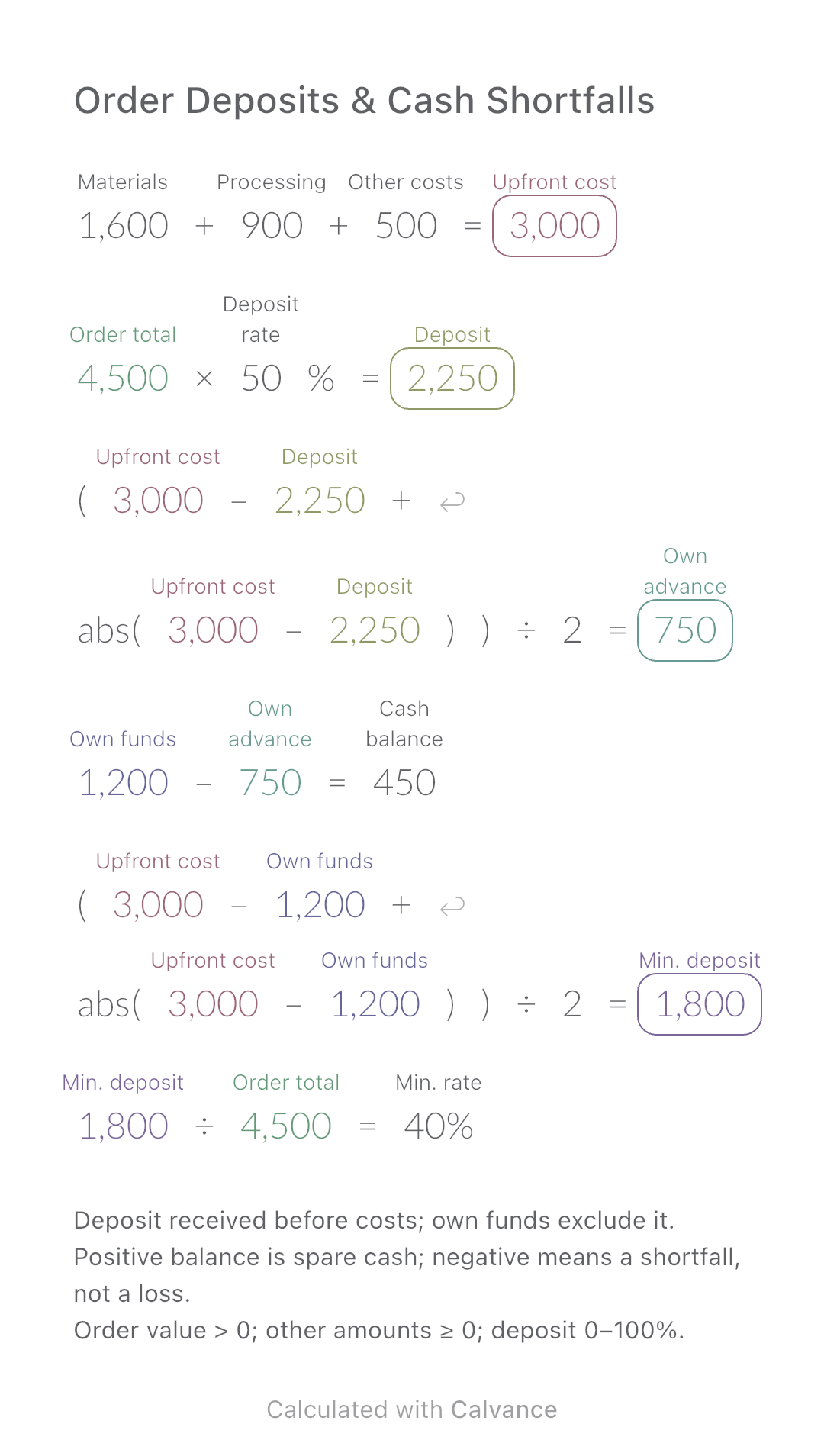
Calculate how much of an order you must fund yourself and the minimum customer deposit needed before production.
View template and methodChoose a plan when you need more canvases, high-resolution image exports, or sync across devices.